
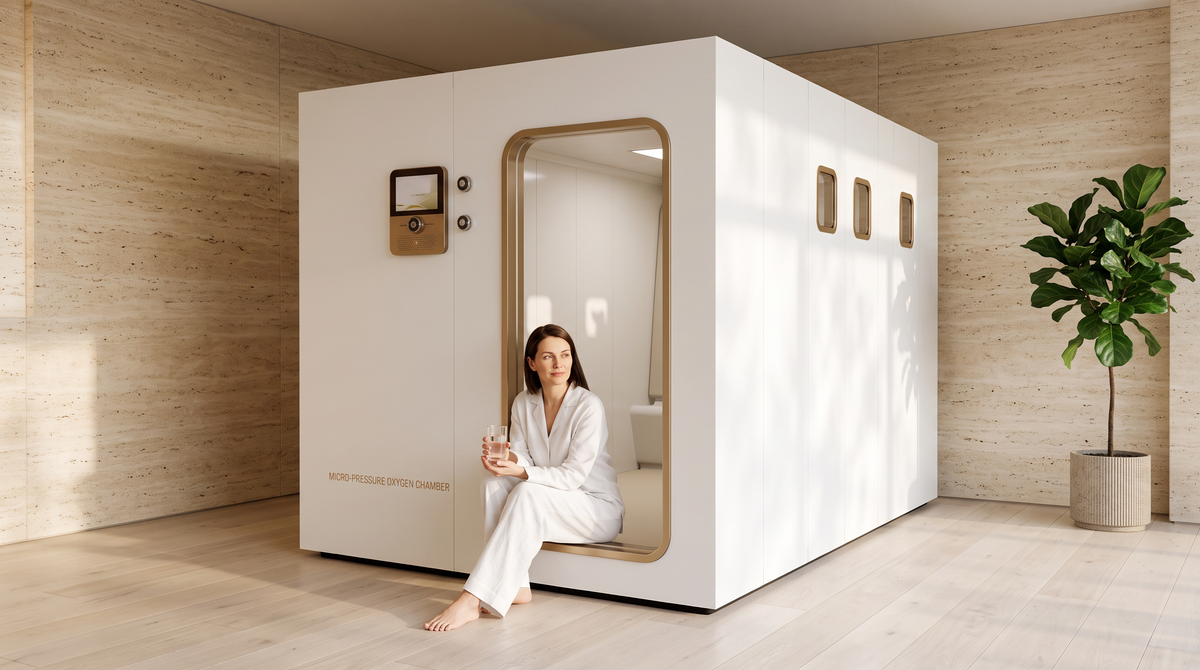
Hyperbaric oxygen means breathing almost pure oxygen, up to 100%, in a chamber where the pressure is higher than atmospheric pressure, so that the oxygen dissolves directly into the blood plasma: at 3 ATA, the oxygen pressure in arterial blood can exceed 2,000 mmHg, compared with roughly 100 mmHg when you breathe ordinary air. That is how oxygen also reaches the tissues where haemoglobin alone no longer delivers enough. At NeuroGenesis DNA we work with hyperbaric chambers for clinics and home use, and below I explain, in plain language, what happens in your body during a session.
In short
- Hyperbaric oxygen therapy combines two things: oxygen in high concentration and increased pressure. Without pressure, extra oxygen adds very little, because haemoglobin is already 94-99% saturated.
- Under pressure, oxygen dissolves into the plasma (Henry's law). The oxygen pressure in arterial blood can climb from under 100 mmHg to over 2,000 mmHg at 3 ATA, and in the tissues it reaches 200-400 mmHg.
- In a study published in the American Journal of Physiology (Thom, 2006), a single 2-hour session at 2.0 ATA doubled the CD34+ stem cells in the blood, and after 20 sessions the increase was 8-fold.
- Pressure matters: medical hyperbaric oxygen therapy is done under medical supervision, usually at 1.9-3.0 ATA, while lower pressures, for example 1.3 ATA, have different effects and indications. Oxygen is the fuel of the mitochondria, the same ones activated by red light therapy, as we explain in the complete guide to red light therapy.

What is hyperbaric oxygen?
Hyperbaric oxygen is oxygen breathed at a pressure higher than the atmospheric pressure at sea level, which is 1 ATA (atmosphere absolute). The word comes from the Greek "hyper" (above) and "baros" (weight, pressure).
The review by Hadanny and Efrati, researchers at the Sagol Center for Hyperbaric Medicine in Israel, published in Biomolecules in 2020, defines hyperbaric oxygen therapy (HBOT) as the inhalation of 100% oxygen at pressures above 1 ATA, with the aim of increasing the amount of oxygen dissolved in the body's tissues. The Undersea and Hyperbaric Medical Society (UHMS), the reference society in the field, states that scientifically supported sessions are usually done at pressures between 1.9 and 3.0 ATA and that medical hyperbaric oxygen therapy requires a doctor's prescription and supervision.
To give you a picture: 2.0 ATA is the pressure you feel at roughly 10 metres under water. The difference is that in a hyperbaric chamber you stay dry, lying down or seated, reading or resting, while your body works with far more oxygen than usual.
How does a hyperbaric chamber work?
A hyperbaric chamber works on a simple principle from physics: the higher the pressure of a gas, the more of that gas dissolves into a liquid. This is Henry's law, the same phenomenon that keeps carbon dioxide dissolved in a sealed bottle of sparkling water.
A session has three stages:
- Compression. The pressure rises gradually, over a few minutes. You feel a "blocked ears" sensation, like on a plane during landing, which you equalise by swallowing or yawning.
- Plateau. You breathe high-concentration oxygen at the target pressure, usually for 60-120 minutes in clinical protocols.
- Decompression. The pressure slowly returns to 1 ATA, and your ears equalise again.
Chambers differ in construction: soft chambers, made of flexible materials, work at low pressures, while hard chambers, with a rigid structure, can reach higher pressures. The models we work with at NeuroGenesis DNA operate between 1.5 and 2.0 ATA, for clinics, spas, hotels and home use.
How does oxygen reach every cell?
The direct answer: normally, oxygen reaches the cells almost exclusively bound to the haemoglobin in red blood cells, and in a hyperbaric chamber it also arrives by a second route, dissolved directly in the plasma.
When you breathe ordinary air, haemoglobin is already 94-99% saturated, and up to 99% of the oxygen in the blood is carried by it, according to the Hadanny and Efrati review. That is why breathing more oxygen at normal pressure changes very little: the "truck" is already full.
Pressure opens a second transport route. Each mmHg of oxygen pressure adds roughly 0.003 ml of dissolved oxygen per 100 ml of blood. With ordinary air, that means about 0.3 ml. When the arterial oxygen pressure passes 2,000 mmHg, the dissolved amount reaches around 6 ml per 100 ml of blood, close to what the tissues consume at rest. The Dutch surgeon Ite Boerema demonstrated this spectacularly in the late 1950s, in a study titled, quite literally, "Life Without Blood".
Plasma is liquid and reaches the places red blood cells struggle to get to: the very fine capillaries, swollen tissues, areas with poor circulation. Thom (2011, Plastic and Reconstructive Surgery) notes that, during a session, the oxygen pressure in the tissues reaches 200-400 mmHg. For the mitochondria, the power plants of the cells, that means more fuel for ATP production.
What happens in the body after several sessions?
The effects that matter most for longevity do not appear during a single session, but through repetition: the body responds to the alternation between high oxygen and normal oxygen as it would to training.
Hadanny and Efrati called this mechanism the hyperoxic-hypoxic paradox. Their explanation: oxygen fluctuations, not only its absolute level, are read by the cells as a signal. After repeated sessions, the activity of the HIF-1 factor increases, which switches on the genes for new blood vessels (through VEGF), the activity of the sirtuin SIRT1 increases and mitochondrial biogenesis appears, that is, the formation of new mitochondria. The authors compare the effect with high-intensity interval training.
Another important result comes from Stephen Thom and his colleagues at the University of Pennsylvania (2006, American Journal of Physiology). In people undergoing hyperbaric oxygen therapy sessions, a single 2-hour session at 2.0 ATA doubled the number of CD34+ stem and progenitor cells in the blood. After 20 sessions, their number was 8 times higher. The mechanism identified was an increase in nitric oxide production in the bone marrow.
What does this mean for you? That hyperbaric oxygen therapy works on the same systems we target in every longevity routine: cellular energy, circulation, inflammation and the body's ability to repair itself. We also explained the link between stress, inflammation and cellular ageing in the article on chronic stress and telomeres.
Which pressure is right: 1.3 ATA, 1.5 ATA or 2.0 ATA?
Pressure is what makes the difference between a relaxation session with oxygen and true hyperbaric oxygen therapy. The UHMS considers that exposures below 1.5 ATA, called "mild hyperbaric", do not yet have evidence for the recognised medical indications, while clinical studies usually use 1.9-3.0 ATA.
| Pressure | Underwater equivalent | Where it is used | What you need to know |
|---|---|---|---|
| 1.3 ATA | ~3 m | Soft chambers, wellness | Gentler effect. Considered "mild hyperbaric", with limited evidence for medical indications. |
| 1.5 ATA | ~5 m | Hard chambers, wellness, longevity clinics | Threshold between wellness and clinical protocols. More dissolved oxygen than at 1.3 ATA. |
| 2.0 ATA | ~10 m | Clinics, research (for example the Thom 2006 study) | The pressure used in many studies. Done under medical supervision. |
| 2.4-3.0 ATA | ~14-20 m | Hyperbaric medicine centres | Strict medical indications (for example decompression sickness, carbon monoxide poisoning). Hospital only. |
Underwater equivalents are approximate. Pressure, duration and number of sessions are set together with your doctor, depending on your goal and your state of health.

NeuroGenesis DNA hyperbaric chambers
15 models, between 1.5 and 2.0 ATA, for clinics, spas, hotels and home use. Delivery, installation and training included.
Personalised offer within 24 hours
Request an offerIs hyperbaric oxygen therapy safe?
Yes, serious adverse effects are rare when sessions are done correctly, with a medical assessment beforehand and trained staff.
The most complete analysis on this subject, published by Heyboer and colleagues in Advances in Wound Care (2017), shows that the most frequent effect is middle ear barotrauma, the unpleasant pressure in the ears, mild in the vast majority of cases. Seizures from oxygen toxicity, linked to the high pressures of medical protocols, occur in roughly 1 in 2,000-3,000 sessions according to recent data. Some people notice temporary short-sightedness after many sessions at 2.0 ATA or more, which usually returns to normal within 3-6 weeks.
A few practical rules we recommend to all our clients:
- Have a medical assessment before your first sessions. Untreated pneumothorax is considered an absolute contraindication, and some lung or ear conditions and some medications call for caution.
- Do not enter the chamber with a cold or sinusitis: your ears equalise much harder.
- Start with low pressures and short sessions, then increase gradually.
- If you have claustrophobia, choose a chamber with large windows and a wide door and tell the operator from day one.
How does oxygen connect with red light therapy?
Oxygen and red light therapy work in the same place: the mitochondrion. Oxygen is the fuel, while red light and near-infrared (NIR) are absorbed by cytochrome c oxidase, the enzyme in the respiratory chain that uses that very oxygen to produce ATP.
In other words, hyperbaric oxygen therapy brings more oxygen to the cells, and red light therapy supports the efficiency with which the mitochondria turn it into energy. That is why many longevity clinics and many athletes use them in the same recovery routine. We wrote at length about what the studies show on red light therapy in the article Red light therapy: benefits and what the studies show.
In my own routine, an oxygen session is often followed by 10-15 minutes in front of a full body panel. It is the moment when the body is already "switched on", relaxed and warmed up.

Red Light Therapy Panel B5040 PRO FullBody Elite
2,016 LEDs over 183 cm, red light and NIR for the whole body in a single session. The choice of longevity clinics and of those who want a complete routine at home.
14,800 RON
See B5040 PROWho is a hyperbaric chamber for?
A hyperbaric chamber is a suitable investment for medical and longevity clinics, recovery centres, spas and hotels that want to offer a premium service, but also for families who want regular sessions at home, with their doctor's agreement.
When choosing a chamber, the important questions are three: what pressure you need for your goal, how many people will use it and how much space you have available. For clinics, daily throughput also matters, while for home use comfort, noise and ease of use matter. We help you answer all three before you receive the offer, and delivery, installation and team training are included.
Frequently asked questions
What is hyperbaric oxygen therapy?
Hyperbaric oxygen therapy (HBOT) means breathing high-concentration oxygen, up to 100%, in a chamber pressurised above atmospheric pressure. The pressure makes oxygen dissolve directly into the plasma, so that the arterial oxygen pressure can exceed 2,000 mmHg at 3 ATA.
How does a hyperbaric chamber work?
A hyperbaric chamber increases the air pressure inside, usually between 1.3 and 3.0 ATA, while you breathe high-concentration oxygen. According to Henry's law, at higher pressure more oxygen dissolves into the plasma, and it also reaches the tissues with poor circulation.
How many hyperbaric oxygen therapy sessions are needed?
It depends on the goal and the pressure. The protocols in studies use series of several sessions, not a single isolated session. In the Thom study from 2006, the number of CD34+ stem cells in the blood doubled after one session at 2.0 ATA and increased 8-fold after 20 sessions. The protocol is set with your doctor.
What is the difference between 1.3 ATA and 2.0 ATA?
At 2.0 ATA, far more oxygen dissolves into the plasma than at 1.3 ATA. The UHMS considers exposures below 1.5 ATA "mild hyperbaric", with limited evidence for medical indications, while clinical studies usually use 1.9-3.0 ATA. Different pressures have different effects and indications.
Does hyperbaric oxygen therapy have side effects?
Serious adverse effects are rare. The most frequent is ear discomfort from the change in pressure. Seizures from oxygen toxicity occur in roughly 1 in 2,000-3,000 sessions at medical pressures, and temporary short-sightedness usually resolves within 3-6 weeks. A medical assessment before starting is essential.
Want a hyperbaric chamber for your clinic or your home?
We have 15 models, between 1.5 and 2.0 ATA, for clinics, spas, hotels and home use. Delivery, installation and training are included, and you receive your personalised offer within 24 hours. Questions? Write to us on WhatsApp at 0723 299 339.
Request an offerNeuroGenesis DNA red light therapy devices come with a 2-year warranty and 14-day returns.
About the author: Andra Manea
Co-Founder and CEO of NeuroGenesis DNA, specialist in Lifestyle Medicine and nutrition. Andra builds longevity routines that combine smart nutrition, movement, oxygen and red light therapy, and translates studies into habits you can apply starting tomorrow.
Read next
- The complete guide to red light therapy
- Red light therapy: benefits and what the studies show
- How much protein after 40: muscle, the organ of longevity
Sources
- Hadanny A, Efrati S. The Hyperoxic-Hypoxic Paradox. Biomolecules. 2020;10(6):958. Biomolecules
- Thom SR. Hyperbaric oxygen: its mechanisms and efficacy. Plast Reconstr Surg. 2011;127(Suppl 1):131S-141S. PMC
- Thom SR, Bhopale VM, Velazquez OC et al. Stem cell mobilization by hyperbaric oxygen. Am J Physiol Heart Circ Physiol. 2006;290(4):H1378-H1386. PubMed
- Heyboer M 3rd, Sharma D, Santiago W, McCulloch N. Hyperbaric Oxygen Therapy: Side Effects Defined and Quantified. Adv Wound Care. 2017;6(6):210-224. PMC
- Undersea and Hyperbaric Medical Society. Indications for Hyperbaric Oxygen Therapy. UHMS
- Van Meter KW. Hyperbaric oxygen therapy in the ATLS/ACLS resuscitative management of acutely ill or severely injured patients with severe anemia: a review. Front Med. 2024;11:1408816. Frontiers
- Hamblin MR. Mechanisms and applications of the anti-inflammatory effects of photobiomodulation. AIMS Biophys. 2017;4(3):337-361. PubMed
This information is for educational purposes and does not replace medical advice. Medical hyperbaric oxygen therapy is done under medical supervision, and the pressure, duration and number of sessions are set by a doctor. Wellness hyperbaric chambers are not intended to treat diseases.



Leave a comment
All comments are moderated before being published.
This site is protected by hCaptcha and the hCaptcha Privacy Policy and Terms of Service apply.