
After 40, you need more protein than the classic recommendation of 0.8 g per kilogram suggests: the international PROT-AGE expert group recommends at least 1.0-1.2 g of protein per kilogram of body weight per day for older adults, split into meals of 25-30 g. The reason is simple: after 40, muscle begins to be lost slowly, and protein, together with strength training, is the best protection against sarcopenia. And for recovery between workouts, many of our longevity routines also include red light therapy panels, because red light therapy supports the energy of muscle cells.
In short
- For older adults, the PROT-AGE recommendation is at least 1.0-1.2 g of protein per kg of body weight per day. For a 70 kg person, that means approximately 70-84 g of protein daily.
- Ageing muscle responds more slowly: in an analysis published in the Journals of Gerontology, older men needed approximately 0.40 g/kg per meal, compared with 0.24 g/kg in young men, for the same maximum effect.
- Distribution matters: 25-30 g of protein at each main meal, with approximately 2.5-2.8 g of leucine, are more effective than a single protein-rich meal in the evening.
- Protein works best together with strength training. In a meta-analysis of 49 studies and 1,863 participants, the additional benefit on muscle mass plateaued at around 1.6 g/kg per day.

What is sarcopenia and why does it start after 40?
Sarcopenia is the progressive loss of muscle mass and strength with age. The European EWGSOP2 consensus, published in Age and Ageing (Cruz-Jentoft and colleagues, 2019), defines it as a disease of the muscle and puts low muscle strength first, not just mass.
The process does not appear overnight at 70. It begins discreetly much earlier, around the age of 30-40, and the pace accelerates with menopause, a sedentary lifestyle and very restrictive diets. What I often see in the women I work with: the scales show the same weight as at 35, but body composition has changed. Less muscle, more fat, less energy on the stairs.
The good news is that muscle is one of the most adaptable tissues in the body. It responds to stimulus at any age, provided it receives the two signals it needs: strength effort and enough protein.
Why is muscle the "organ of longevity"?
Muscle is much more than strength and appearance: it is a metabolic organ that consumes glucose, supports hormonal balance and keeps you independent as you get older.
A study published in The American Journal of Medicine (Srikanthan and Karlamangla, 2014) followed 3,659 adults from the American NHANES III cohort, men over 55 and women over 65. The conclusion was clear: mortality was significantly lower in those with the highest muscle mass relative to height, compared with those with the lowest muscle mass. The authors concluded that, in older adults, body composition says more about longevity than body mass index.
That is why, in the longevity routines we build at NeuroGenesis DNA, muscle comes first. It is your biological "pension": the more you put aside now, the more reserve you have later. We also explained the link between stress, inflammation and ageing in the article on chronic stress and telomeres.
How much protein do you need per day after 40?
The direct answer: 1.0-1.2 g of protein per kilogram of body weight per day as a baseline for healthy older adults, and up to approximately 1.6 g/kg if you do strength training and want to build muscle.
The recommendation comes from the position of the PROT-AGE group (Bauer and colleagues, 2013), published in the Journal of the American Medical Directors Association, and is also adopted by ESPEN, the European Society for Clinical Nutrition (Deutz and colleagues, 2014). For people with acute or chronic illness, the same guidelines raise the recommendation to 1.2-1.5 g/kg per day, except for those with severe kidney disease, where the dose is set with the doctor.
To make it easy, here is the calculation for a few body weights:
| Your weight | Baseline: 1.0-1.2 g/kg | With strength training: ~1.6 g/kg | Per meal (3 meals) |
|---|---|---|---|
| 55 kg | 55-66 g/day | ~88 g/day | ~22-30 g |
| 65 kg | 65-78 g/day | ~104 g/day | ~25-35 g |
| 75 kg | 75-90 g/day | ~120 g/day | ~25-40 g |
| 85 kg | 85-102 g/day | ~136 g/day | ~30-45 g |
Indicative values for healthy adults, calculated according to the PROT-AGE recommendations and the Morton 2018 meta-analysis. If you have a kidney or liver condition, discuss the dose with your doctor.
How much protein per meal stimulates muscle?
For an adult over 40, the practical target is 25-30 g of quality protein at each main meal, that is approximately 2.5-2.8 g of leucine, the amino acid that gives the "start signal" to muscle synthesis.
The phenomenon is called anabolic resistance: ageing muscle needs a stronger stimulus to start the same construction. Moore and colleagues (2015), in The Journals of Gerontology, reanalysed data from several studies and calculated that older men needed approximately 0.40 g of protein per kg of body weight at a meal to maximally stimulate muscle protein synthesis, compared with approximately 0.24 g/kg in young men. That means approximately two thirds more, relative to body weight.
In practice, the most common mistake I see is distribution: a breakfast of coffee and a croissant (5-8 g of protein), a quick lunch and a rich dinner. The day's total may look right, but the muscle receives the building signal only once a day. Moving 20-25 g of protein to breakfast is, very often, the simplest change with the biggest effect.
Which foods should your protein come from after 40?
The best strategy is the combination: animal sources rich in leucine, complemented by legumes, seeds and fermented dairy, which also bring fibre and polyphenols.
| Food (portion) | Approximate protein | Why we choose it |
|---|---|---|
| Salmon, 150 g cooked | ~30-33 g | Complete protein plus omega-3 |
| Chicken breast, 120 g cooked | ~35-37 g | High protein density, few calories |
| 2 large eggs | ~12-13 g | Leucine, choline, easy to add at breakfast |
| Greek yoghurt, 200 g | ~18-20 g | Fermented dairy, snack or breakfast |
| Cooked lentils, 200 g | ~17-18 g | Fibre and plant protein, ideal in salads |
| Cottage cheese, 150 g | ~16-18 g | Rich in casein, filling in the evening |
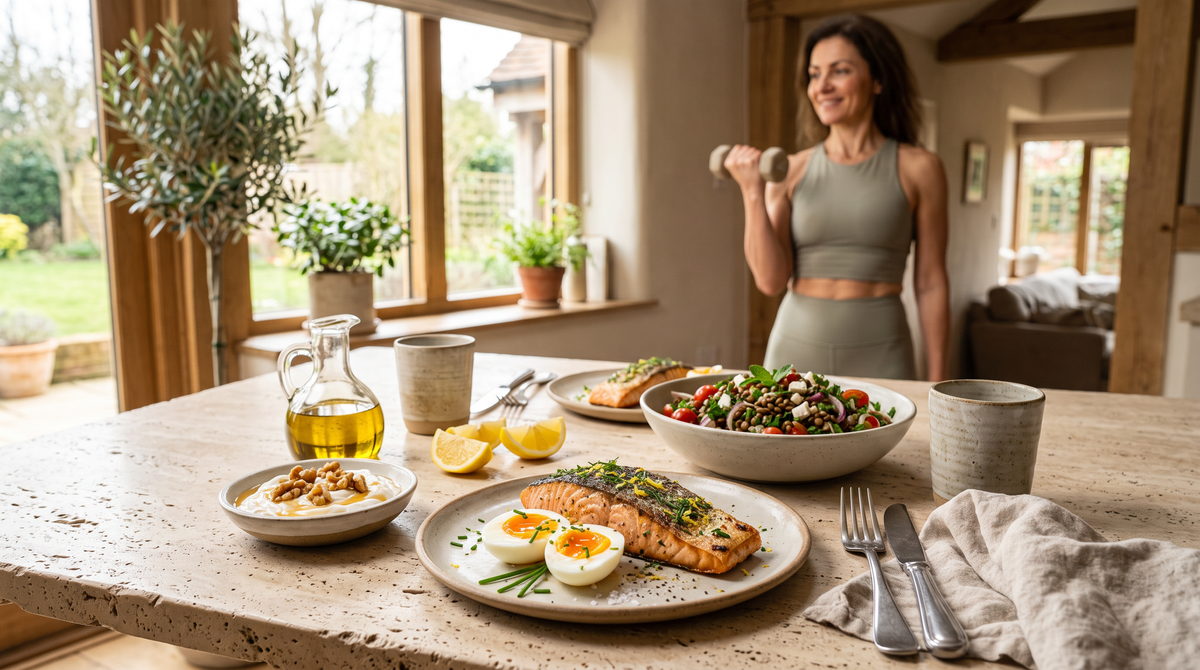
A meal like the one in the picture above, with salmon, eggs, lentil salad and yoghurt with nuts, easily exceeds 40 g of protein. If you eat mostly plant-based, combine legumes with whole grains and seeds and aim for the upper end of the range, because plant proteins usually contain less leucine.
Does protein work without strength training?
Protein alone slows down muscle loss, but real building happens when you combine it with strength training.
In the Health ABC study (Houston and colleagues, 2008, The American Journal of Clinical Nutrition), 2,066 adults aged 70 to 79 were followed for three years. Those in the quintile with the highest protein intake lost approximately 40% less lean mass than those in the quintile with the lowest intake.
For gaining muscle, the data are even clearer. The meta-analysis by Morton and colleagues (2018), published in the British Journal of Sports Medicine, brought together 49 randomised studies with 1,863 participants. Protein supplementation significantly increased the gains in strength and muscle mass obtained through training, and the benefit plateaued at around 1.62 g/kg per day. An important detail for us: the effect was smaller with age, and the authors suggest that older people need a higher intake to respond just as well. A more recent meta-analysis, published in 2022 in the Journal of Cachexia, Sarcopenia and Muscle (Nunes and colleagues), confirmed that a higher protein intake supports muscle mass, especially when combined with strength training.
The practical conclusion: 2-3 strength sessions per week, with weights or resistance bands, plus the right protein at every meal. The rest is optimisation.
How does red light therapy help muscle recovery?
Red light therapy supports recovery because red light and near-infrared (NIR) light are absorbed by the mitochondria in muscle fibres, which then produce more ATP, the cellular energy.
The meta-analysis published in Lasers in Medical Science (Leal-Junior and colleagues, 2015) analysed the randomised, placebo-controlled studies on phototherapy and exercise. Phototherapy applied before exercise was associated with more repetitions, a longer time to exhaustion and lower creatine kinase values, a marker of muscle micro-damage. In other words, red light therapy can support both performance and recovery between workouts.
After 40, recovery often becomes the factor that limits progress: if everything hurts for three days after a workout, you never get to the second one. I use red light therapy as a 10-15 minute ritual after training or in the evening, for the legs, back and shoulders. I wrote separately about the effects on joints, in the article on red light therapy for joint pain.

MAT 360 Recovery Pro Red Light Therapy Mat
360 LEDs, red light and NIR over 100 cm. You lie down for 15-20 minutes after training, for the back, hips and legs.
1,030 RON
See the mat
B600 PRO Compact Red Light Therapy Panel
240 LEDs over 62 cm, red and NIR. Ideal for targeted areas: thighs, shoulders, back, at home.
1,760 RON
See B600 PRO
B1500 PRO Performance Red Light Therapy Panel
900 LEDs over 91 cm, for half the body in a single session. The choice of those who train often.
4,150 RON
See B1500 PROWhat does a day with enough protein look like after 40?
A simple example for a 65 kg woman, aiming for approximately 100 g of protein per day and doing strength training three times a week:
| When | What you eat | Protein |
|---|---|---|
| Breakfast | 2 eggs, 150 g Greek yoghurt with nuts and berries | ~27 g |
| Lunch | 120 g salmon, salad with 150 g lentils and olive oil | ~40 g |
| Post-workout snack | 150 g cottage cheese or a protein shake | ~17-20 g |
| Dinner | Chicken breast or tofu with oven-roasted vegetables | ~20-30 g |
You do not have to weigh every meal for the rest of your life. Do the exercise for two weeks, to calibrate your eye, then work by the simple rule: a palm-sized portion of protein at every meal.
Frequently asked questions
How much protein do you need per day after 40?
For healthy older adults, the PROT-AGE group recommends at least 1.0-1.2 g of protein per kilogram of body weight per day. If you do strength training, the benefits for muscle mass continue up to approximately 1.6 g/kg per day.
What is sarcopenia and at what age does it appear?
Sarcopenia is the progressive loss of muscle mass and strength with age. The process begins slowly after 30-40 and accelerates with a sedentary lifestyle and menopause. Strength training and enough protein are the main methods of prevention.
Does too much protein affect the kidneys?
For healthy adults, intakes of 1.0-1.6 g/kg per day are frequently used in studies. People with chronic kidney disease need a dose set together with their doctor, because the recommendations are different in this case.
Can I eat all of the day's protein in a single meal?
It is more efficient to split it. After 40, muscle responds best to 25-30 g of quality protein at each main meal, with approximately 2.5-2.8 g of leucine, rather than to a single very rich meal.
Does red light therapy help muscle recovery?
Yes, a meta-analysis published in Lasers in Medical Science associated phototherapy applied before exercise with more repetitions, a longer time to exhaustion and lower markers of muscle damage. Red light therapy complements, it does not replace, training and protein.
Build your recovery routine at home
All NeuroGenesis DNA devices come with a 2-year warranty, 14-day returns and local support in Romania. Not sure which panel or mat suits your training routine? Write to us on WhatsApp at 0723 299 339 and we will help you choose in a few minutes.
See the red light therapy panelsAbout the author: Andra Manea
Co-Founder and CEO of NeuroGenesis DNA, specialist in Lifestyle Medicine and nutrition. Andra builds longevity routines that combine smart nutrition, movement and recovery, and translates studies into habits you can apply starting tomorrow.
Read also
- The complete guide to red light therapy
- Red light therapy: benefits and what the studies show
- Chronic stress and ageing: what happens to telomeres
Sources
- Bauer J, Biolo G, Cederholm T et al. Evidence-based recommendations for optimal dietary protein intake in older people: a position paper from the PROT-AGE Study Group. J Am Med Dir Assoc. 2013;14(8):542-559. PubMed
- Deutz NEP, Bauer JM, Barazzoni R et al. Protein intake and exercise for optimal muscle function with aging: recommendations from the ESPEN Expert Group. Clin Nutr. 2014. ESPEN
- Cruz-Jentoft AJ, Bahat G, Bauer J et al. Sarcopenia: revised European consensus on definition and diagnosis. Age Ageing. 2019;48(1):16-31. PMC
- Srikanthan P, Karlamangla AS. Muscle mass index as a predictor of longevity in older adults. Am J Med. 2014;127(6):547-553. PubMed
- Moore DR, Churchward-Venne TA, Witard O et al. Protein ingestion to stimulate myofibrillar protein synthesis requires greater relative protein intakes in healthy older versus younger men. J Gerontol A Biol Sci Med Sci. 2015;70(1):57-62. PubMed
- Houston DK, Nicklas BJ, Ding J et al. Dietary protein intake is associated with lean mass change in older, community-dwelling adults: the Health, Aging, and Body Composition (Health ABC) Study. Am J Clin Nutr. 2008;87(1):150-155. PubMed
- Morton RW, Murphy KT, McKellar SR et al. A systematic review, meta-analysis and meta-regression of the effect of protein supplementation on resistance training-induced gains in muscle mass and strength in healthy adults. Br J Sports Med. 2018;52(6):376-384. PMC
- Nunes EA, Colenso-Semple L, McKellar SR et al. Systematic review and meta-analysis of protein intake to support muscle mass and function in healthy adults. J Cachexia Sarcopenia Muscle. 2022. PMC
- Leal-Junior ECP, Vanin AA, Miranda EF et al. Effect of phototherapy (low-level laser therapy and light-emitting diode therapy) on exercise performance and markers of exercise recovery: a systematic review with meta-analysis. Lasers Med Sci. 2015. PubMed
This information is for educational purposes and does not replace medical advice. If you have a kidney, liver or metabolic condition, set your protein intake together with your doctor.




Leave a comment
All comments are moderated before being published.
This site is protected by hCaptcha and the hCaptcha Privacy Policy and Terms of Service apply.