
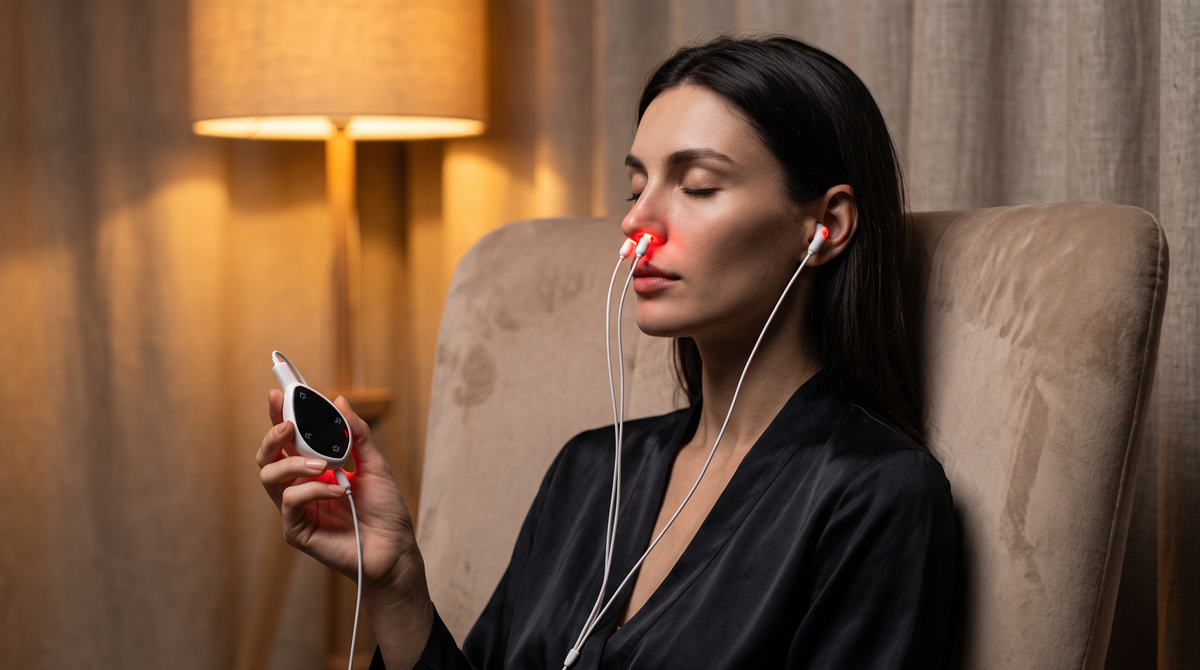
Intranasal photobiomodulation means applying red and near-infrared (NIR) light directly inside the nostrils, where the thin, richly vascularised mucosa sits just a few centimetres from the base of the brain. It is one of the shortest routes by which red light therapy reaches the brain, alongside application on the forehead, where a pilot study at Massachusetts General Hospital reduced the anxiety score by almost 60% in 8 weeks. At NeuroGenesis DNA we use for this ritual the red light therapy device for nose and ears, and below I explain, as a psychologist and neuroscience researcher, what happens in your brain and what the studies honestly show.
In short
- Red light (around 630-660 nm) and NIR (810-850 nm) are absorbed by the mitochondria of neurons and support energy production (ATP), cerebral circulation and an anti-inflammatory response. The mechanism is explained in the complete guide to red light therapy.
- Through the nose, red light bypasses a large part of the skull bone. The simulations cited by Salehpour and colleagues (2020) show that a source placed in the nasal cavity delivers more energy to the ventromedial prefrontal cortex, a key area for emotional regulation, than one placed on the forehead.
- Anxiety: in the Maiello study (2019), 8 weeks of NIR light therapy on the forehead lowered the HAM-A anxiety score from 16.75 to 6.83 points, and the time to fall asleep was significantly reduced.
- Sleep: a 2025 systematic review of 17 studies shows that the evidence for sleep and wakefulness is promising, but still early. The best results appear when red light therapy is part of a consistent calming routine.

What is intranasal photobiomodulation?
Intranasal photobiomodulation is the application of low-intensity red or near-infrared light through a small probe gently inserted into the nostril. It does not heat and does not cut the tissue: the red light is absorbed by the cells and changes their energy metabolism.
The term comes from the scientific literature, where it appears as "intranasal photobiomodulation" (i-PBM). The review published in Reviews in the Neurosciences in 2020 by Farzad Salehpour, Michael Hamblin, Paolo Cassano and colleagues describes this route as a non-invasive way of bringing red light therapy closer to the brain, used alone or together with devices applied to the head.
In my practice, people often ask me: "Why through the nose?". The answer lies in anatomy, and it is simpler than it seems.
How does red light reach the brain through the nose?
In short: above the nasal cavity sits the cribriform plate, a thin plate of bone, and immediately above it sit the olfactory bulb and the lower part of the frontal lobes. Red light has far less bone to cross than through the forehead.
The skull is a powerful filter. In the cadaver studies cited by Salehpour, only 0.5% of 633 nm light and 2.1% of 830 nm light pass through one centimetre of frontal bone and tissue. That is why the Monte Carlo modelling in the same review showed that a light source placed near the cribriform plate delivers the largest amount of energy to the ventromedial prefrontal cortex and the ventromedial orbitofrontal cortex, compared with application on the forehead.
Why does this matter for how you feel? The ventromedial prefrontal cortex is one of the "brakes" on the amygdala, the brain's alarm centre. When it works well, you can feel an intense emotion without being swept away by it. When it is tired or overloaded, stress feels bigger than it is and sleep becomes fragmented.
There is a second route too. The nasal mucosa has a great many capillaries, with blood that flows relatively slowly. The review's authors note that irradiating the blood through the nose may also have systemic effects, through the blood cells, which may contribute to the effects observed on the brain.
| Route | Where the light reaches | What we know from studies |
|---|---|---|
| Intranasal (nose) | Base of the frontal lobes, olfactory bulb, mucosal capillaries | Small studies and case series, usually with 633 nm or 810 nm, often combined with application on the head |
| Transcranial (forehead) | Prefrontal cortex, through bone | Pilot studies on anxiety and depression, with NIR 810-830 nm |
| Panel on the body | Skin, muscles, circulation, systemic effects | Most studies: skin, recovery, joints, sleep in athletes |
Studies on the brain are still few and small. They show a clear direction, but they do not replace the assessment and treatment recommended by a doctor or psychotherapist.
What does red light do in your neurons?
Red light and NIR are absorbed by cytochrome c oxidase, an enzyme in the mitochondria. The result is more ATP, more local blood flow and an anti-inflammatory signal, as Michael Hamblin describes in his 2016 review on photobiomodulation of the brain.
Your brain consumes roughly one fifth of the body's energy, although it weighs about 2% of its weight. Neurons are among the "hungriest" cells in the body. When you live for months in chronic stress, with high cortisol and little sleep, their mitochondria run in emergency mode. We wrote about how stress leaves traces right down to DNA level in the article on chronic stress and telomeres.
Red light therapy does not forcibly "calm" the nervous system the way a sedative does. Rather, it supports the energy resources of the neurons, and a brain with more energy regulates its emotions, attention and sleep-wake rhythm more easily.
Does red light therapy help with anxiety? What the studies say
The direct answer: pilot studies from Harvard and Massachusetts General Hospital show significant reductions in anxiety after red light and NIR therapy applied to the head, but the groups are small and larger studies are needed.
Schiffer and colleagues, 2009 (Behavioral and Brain Functions). Ten patients with major depression and anxiety received a single session of 810 nm NIR light on the forehead, 4 minutes on each of two areas. After 2 weeks, the HAM-A anxiety score had dropped by an average of 14.9 points, and after 4 weeks by 9 points. The HAM-D depression score dropped by 13.2 points at 2 weeks.
Maiello and colleagues, 2019 (Photobiomodulation, Photomedicine, and Laser Surgery). Fifteen people with generalised anxiety disorder applied 830 nm NIR light to their own forehead at home, daily, for 20 minutes, over 8 weeks. In those who completed the study, anxiety fell from 16.75 to 6.83 points on the HAM-A scale. A detail that interests me a lot as a psychologist: the time to fall asleep was also significantly reduced.
The intranasal route. The Salehpour review (2020) describes the case of a person who used 810 nm NIR light in both nostrils for 22 months. As the sessions became more frequent, anxiety symptoms decreased roughly threefold on the anxiety questionnaire. It is a single case, so I read it as a signal, not as proof.
The big picture. A meta-analysis published in Frontiers in Psychiatry in 2024 (Ji and colleagues), with 11 randomised studies and 407 participants, found that photobiomodulation reduces depressive symptoms, with a moderate effect. The authors clearly say that studies are still few and that further research is needed. For an overview of the evidence, also read the article Red light therapy: benefits and what the studies show.

Red Light Therapy Device for Nose and Ears
660 nm red light and 810 nm infrared, with dedicated probes for the nose and for the ears. A hands-free ritual of 10-15 minutes a day, with touch screen, adjustable intensity and rechargeable battery.
588 RON · limited stock
See the deviceCan red light therapy improve sleep?
Yes, there are good signals: in several studies, people fell asleep faster and reported more restful sleep. The evidence is still early, however, and the time of day and the dose matter.
The most recent synthesis, published in 2025 in Frontiers in Behavioral Neuroscience by Gaggi and colleagues from NYU and Mount Sinai, analysed 17 studies on sleep and wakefulness after photobiomodulation of the brain. Their conclusion: there is growing evidence that sleep and wakefulness can improve, but not all studies are positive, and the literature is "still in its early stages". They also note that, in some people, red light therapy was rather activating.
The case series published by Saltmarche and colleagues (2017), with 5 patients with mild to moderate dementia, used 12 weeks of 810 nm NIR light, intranasally and on the head. Besides an improvement in the MMSE cognitive score by an average of 2.6 points, families reported better sleep, less anxiety and fewer outbursts of anger.
In athletes, the study by Zhao and colleagues (2012, Journal of Athletic Training) showed that 14 evenings of full body red light therapy, 30 minutes each, improved sleep quality and melatonin levels in female basketball players. If you want a panel for the evening, but also for skin and recovery, the portable CORE 120 panel is a compact option for the bedside table.
What this means for you, in practice: if you feel more alert after the session, move the ritual to the afternoon. If you feel soft and calm, the evening is your moment.
How do you build your evening ritual for the brain?
The most effective ritual is the one you repeat: 10-15 minutes of red light therapy, in the same place, at about the same time, with your phone far away. For the brain, consistency is itself a signal of safety.
As a psychologist, I see every day how hard it is to switch off the mind in the evening by willpower. It works much more easily through the body. A fixed ritual tells the nervous system that the day is over, and the brain learns the association within a few weeks, just as it learns any habit.
| When | What you do | Duration | Why it helps |
|---|---|---|---|
| In the evening, 60-90 minutes before sleep | The nose and ear device, lying down or in an armchair, warm lights in the room | 10-15 minutes | Red light supports the neurons' energy, while the position and the quiet prepare the transition to sleep |
| During the session | Slow breathing, with the exhale longer than the inhale, guided by CALM One | a few minutes | A long exhale activates the vagus nerve and lowers the heart rate |
| After the session | No screens, dim light, cool room | until sleep | You protect your natural melatonin secretion |
If you notice that the ritual activates you, move it to the afternoon. For durations and frequencies for each type of device, see also the guide how many minutes of red light therapy a day.

CALM One Anti-Stress Breathwork Pendant
A simple tool, worn around the neck, that slows down your exhale. The body receives the safety signal that no thought can transmit. The ideal partner for the evening red light therapy ritual.
135 RON
See CALM OneWhat is the role of the ear probe?
The ear probe makes the ritual more complete and more relaxing, but the brain studies cited here used the intranasal route and application on the forehead. I tell you this directly, because trust is built on data, not on promises.
Many of our clients use both probes in the same session: the nose for the route to the brain, the ears for a feeling of calm and "disconnection" that helps them stay still for the 10-15 minutes. From a psychological point of view, exactly this pause, without phone and without stimuli, is an important part of the benefit.
Is intranasal photobiomodulation safe?
Yes, at the low intensities of home-use devices, intranasal red light therapy is considered a non-invasive and well-tolerated method. A few simple rules help you use it correctly:
- Insert the probe gently, only at the entrance of the nostril, and clean it after each use.
- Do not use the device on irritated or injured mucosa or immediately after a nasal procedure.
- If you are pregnant, have epilepsy, take photosensitising medication or are following psychiatric treatment, talk to your doctor first.
- Red light therapy can complement psychotherapy and treatment, but it does not replace them. If anxiety affects your daily life, seek the help of a specialist.
Frequently asked questions
What is intranasal photobiomodulation?
Intranasal photobiomodulation is the application of low-intensity red or near-infrared light directly into the nostril. The red light reaches the richly vascularised mucosa below the base of the brain, where the bone is much thinner than at the forehead, and supports the cells' energy metabolism.
Does red light help with anxiety?
The pilot studies are encouraging. In the 2019 Maiello study, 8 weeks of 830 nm NIR light applied to the forehead reduced the HAM-A anxiety score from 16.75 to 6.83 points. The groups are small, however, and red light therapy complements, rather than replaces, psychotherapy or medical treatment.
Does red light therapy help with sleep?
There are good signals. A 2025 systematic review of 17 studies shows growing evidence for better sleep and wakefulness, but also that the literature is still early. In the Maiello study, the time to fall asleep was significantly reduced after 8 weeks.
How long do you use the nose and ear device?
The recommended ritual is 10-15 minutes a day, preferably at the same time. Consistency matters more than duration: the pilot studies on the brain, like Maiello's, used daily sessions over several weeks.
Is it better to use red light in the morning or in the evening?
It depends on how you react. Some people feel calmer and fall asleep more easily after an evening session, others feel more alert. If you feel activated after the session, move the ritual to the afternoon and keep the evening for slow breathing and dim light.
Start the evening ritual for your brain
The red light therapy device for nose and ears and CALM One form a 15-minute ritual for calm and sleep. All NeuroGenesis DNA devices come with a 2-year warranty and 14-day returns. Questions? Write to us on WhatsApp at 0723 299 339.
See the nose and ear deviceAbout the author: Liliana Cristea
Psychologist and neuroscience researcher, Co-Founder and CSO of NeuroGenesis DNA. Liliana studies the link between brain, emotions and body and explains in plain language what happens in the nervous system under stress, in anxiety and in sleep, so that everyone can build routines that truly help them.
Read next
- The complete guide to red light therapy
- Chronic stress and ageing: what happens to telomeres
- How many minutes of red light therapy a day
Sources
- Salehpour F, Gholipour-Khalili S, Farajdokht F et al. Therapeutic potential of intranasal photobiomodulation therapy for neurological and neuropsychiatric disorders: a narrative review. Rev Neurosci. 2020;31(3):269-286. PubMed
- Maiello M, Losiewicz OM, Bui E et al. Transcranial Photobiomodulation with Near-Infrared Light for Generalized Anxiety Disorder: A Pilot Study. Photobiomodul Photomed Laser Surg. 2019;37(10):644-650. PubMed
- Schiffer F, Johnston AL, Ravichandran C et al. Psychological benefits 2 and 4 weeks after a single treatment with near infrared light to the forehead: a pilot study of 10 patients with major depression and anxiety. Behav Brain Funct. 2009;5:46. PubMed
- Saltmarche AE, Naeser MA, Ho KF, Hamblin MR, Lim L. Significant Improvement in Cognition in Mild to Moderately Severe Dementia Cases Treated with Transcranial Plus Intranasal Photobiomodulation: Case Series Report. Photomed Laser Surg. 2017;35(8):432-441. PubMed
- Gaggi NL, Parincu Z, Peterson A et al. Enhancing sleep, wakefulness, and cognition with transcranial photobiomodulation: a systematic review. Front Behav Neurosci. 2025;19:1542462. PubMed
- Ji Q, Yan S, Ding J et al. Photobiomodulation improves depression symptoms: a systematic review and meta-analysis of randomized controlled trials. Front Psychiatry. 2024;14:1267415. Frontiers
- Hamblin MR. Shining light on the head: Photobiomodulation for brain disorders. BBA Clin. 2016;6:113-124. PubMed
- Zhao J, Tian Y, Nie J, Xu J, Liu D. Red light and the sleep quality and endurance performance of Chinese female basketball players. J Athl Train. 2012;47(6):673-678. PubMed
This information is for educational purposes and does not replace medical advice. NeuroGenesis DNA red light therapy devices are intended for wellbeing and are not intended to diagnose or treat diseases. If you are dealing with anxiety, insomnia or depression, seek the support of a doctor or psychotherapist.


Leave a comment
All comments are moderated before being published.
This site is protected by hCaptcha and the hCaptcha Privacy Policy and Terms of Service apply.