

Chronic stress is the state in which the body's alarm system stays switched on for weeks or months, never quite settling back into calm. Studies show that this permanent alarm leaves a trace all the way down to the DNA: in the telomeres, the protective caps at the ends of our chromosomes, considered one of the biological markers of aging. The link between stress and aging therefore rests on something measurable. The good news is that the nervous system can learn safety again, and simple tools, such as the CALM One breathing pendant, can help you practise that return every day. Below, as a psychologist and neuroscientist, I explain what happens in the brain and in the cells, and what you can actually do about it.
In short
- Telomeres shorten with every cell division. Chronic stress is associated with faster shortening and with lower activity of telomerase, the enzyme that protects them.
- In a study published in PNAS, the women with the highest perceived stress had telomeres shorter by the equivalent of at least 10 years of aging and 48% lower telomerase activity.
- How the body reacts to stress matters a great deal: cortisol that spikes hard and fails to come down in the evening is associated with shorter telomeres.
- Vigorous exercise, meditation and slow-breathing practices are associated with a better telomere or telomerase profile. A daily rhythm matters more than intensity.

What are telomeres, and why are they called the "cell's clock"?
Telomeres are repetitive DNA sequences that cap the ends of chromosomes, much like the plastic tip that keeps a shoelace from fraying. With every cell division, they lose a small portion. Once they become too short, the cell can no longer divide properly and enters senescence, a kind of biological "retirement" in which it produces inflammatory signals.
The body also has a repair mechanism: telomerase, an enzyme that can add back part of the lost sequences. Elizabeth Blackburn received the Nobel Prize in 2009, together with Carol Greider and Jack Szostak, for discovering how telomeres and telomerase protect chromosomes. Blackburn later worked with psychologist Elissa Epel on precisely the question that interests us here: can the mind influence this clock?
Telomere length is a statistical indicator, not an individual verdict. In an analysis published in JAMA Internal Medicine covering 472,432 UK Biobank participants followed for an average of 12 years, shorter telomeres were associated with a slightly higher risk of mortality, an 8% increase for every standard deviation of shortening, and with stronger associations for certain diseases.
What happens in the brain and body when stress becomes chronic?
In short: the brain perceives a threat, sends the signal to the adrenal glands, and the body lives in "survival" mode even after the real danger has passed.
It all starts in the amygdala, the brain's danger-detection centre. It activates the hypothalamus, which switches on the hypothalamic-pituitary-adrenal axis (the HPA axis). The result is the release of cortisol and adrenaline. In the short term, this is a wonderful mechanism: it gives you energy, focus and a quick reaction. The problem begins when the alarm never switches off. A tense email, a financial worry, an unresolved conflict or a sick child at home can keep the HPA axis activated day after day.
In my practice I often see the same pattern: people who say "I'm not stressed, I just have a lot on", yet sleep lightly, wake up tired, carry tension in their shoulders and feel a vague restlessness in the evening. Their body knows something their mind has not yet named. Over time, this state carries a biological cost: more oxidative stress, more inflammation and a reduced capacity of the cells to repair themselves.
What do the studies say about stress and telomeres?
The direct answer: chronic stress is consistently associated with shorter telomeres and lower telomerase activity, and the effect is stronger for long-lasting stress and for stress experienced as uncontrollable.
Epel and colleagues (2004), in PNAS, studied 58 healthy mothers, some of whom were caring for a child with a chronic illness. The women with the highest perceived stress had telomeres shorter by the equivalent of at least a decade of additional aging (estimated at between 9 and 17 years), 48% lower telomerase activity and higher oxidative stress. One detail matters to me as a psychologist: it was not only the objective situation that counted, but also the way the women perceived their stress, as well as the number of years spent caregiving.
Mathur and colleagues (2016), in Brain, Behavior, and Immunity, pooled 22 studies with 8,724 participants. The association between perceived stress and shorter telomeres was small (r = -0.06) but consistent. In other words, one hard day will not shorten your telomeres. Years lived under tension, however, add up.
Tomiyama and colleagues (2012), in Physiology & Behavior, showed in 23 postmenopausal women that a stronger cortisol response to a stress test, higher night-time cortisol and a "flatter" daily cortisol curve were associated with shorter telomeres. The study is small and preliminary, but the direction is clear: what matters is how quickly your nervous system returns to calm.
| Study | Participants | What it measured | Main result |
|---|---|---|---|
| Epel et al., 2004, PNAS | 58 mothers | Perceived stress, years of caregiving, telomeres, telomerase | Telomeres shorter by the equivalent of at least 10 years, 48% lower telomerase at high stress |
| Mathur et al., 2016, meta-analysis | 8,724 | Perceived stress and telomere length | Small but consistent association (r = -0.06) |
| Tomiyama et al., 2012 | 23 women | Cortisol under stress, night-time cortisol, telomeres | More reactive cortisol and higher night-time cortisol, associated with shorter telomeres |
| Puterman et al., 2010, PLoS ONE | 62 women | Stress, vigorous exercise, telomeres | In active women, stress was no longer associated with shorter telomeres |
| Jacobs et al., 2011 | 60 (30 + 30) | 3-month meditation retreat, telomerase | Telomerase activity roughly one third higher than in the control group |
Does cortisol age our cells?
Cortisol itself is not the enemy. Without it, you would not wake up in the morning. What seems to matter is the rhythm: healthy cortisol rises in the morning and falls gradually towards the evening. When the curve flattens and cortisol stays high at night, the body no longer gets the signal that it can switch into repair mode.
Sleep is when this restoration process is most active. That is why chronic stress and poor sleep feed each other: an agitated brain sleeps lightly, and light sleep makes the brain even more reactive the next day. If you recognise yourself here, the first step is not to "think positive" but to give your body physical signals of safety.
Can telomeres be protected? What works against chronic stress
Yes, research suggests that telomeres and telomerase respond to lifestyle. There is no magic pill, but there are a few directions with solid evidence.
Exercise. Puterman and colleagues (2010) followed 62 postmenopausal women. In inactive women, high stress was associated with shorter telomeres. In those who did at least 42 minutes of vigorous exercise over three days on average, this association disappeared. Exercise appears to act as a buffer between stress and the cells.
Meditation and attention training. Jacobs and colleagues (2011) compared 30 participants in a three-month meditation retreat with 30 people in a control group. At the end, telomerase activity was roughly one third higher in the meditation group, and the effect was linked to a greater sense of control and purpose. Conklin and colleagues (2018) observed, after a one-month retreat, an apparent increase in telomere length compared with meditators who did not attend.
Slow breathing. Breathing is the only automatic function you can control consciously, and a prolonged exhale activates the parasympathetic branch of the nervous system through the vagus nerve. Balban and colleagues (2023), in Cell Reports Medicine, tested breathing practices of just 5 minutes a day for one month in 108 people. All of them reduced anxiety, and the practice focused on a long exhale improved wellbeing more than mindfulness meditation and lowered the resting breathing rate.
How do you train your nervous system to return to calm every day?
The short answer: through small repetitions tied to fixed moments of the day. The brain learns safety the way it learns any other habit, through repetition, not willpower.
What I recommend to the people I work with is to have a physical "anchor", an object that automatically triggers the calm ritual. This is where CALM One comes in: a breathwork pendant you wear around your neck that helps you slow down and lengthen your exhale wherever you are, in a meeting, in traffic or before sleep. Because it is always with you, it turns a few minutes of breathing into a gesture you actually make, rather than an intention you keep postponing.

CALM One, anti-stress breathwork pendant
304 stainless steel, 65 mm. Helps you lengthen your exhale and send your body the signal of safety, in a few minutes, anywhere.
135 RON
See CALM OneCan red light therapy help a stressed brain?
Red and near-infrared light are increasingly being studied for the brain, and the early data are promising, though still preliminary. The mechanism is the same as in the rest of the body: the mitochondria in neurons absorb red light and produce more energy, and a brain with enough energy copes better with stress.
The nose and ears are interesting gateways to the brain, because the tissue there is thin and richly vascularised. In a case series published in Photomedicine and Laser Surgery (Saltmarche et al., 2017), five patients used a transcranial plus intranasal 810 nm device for 12 weeks. Cognitive scores improved, and patients and caregivers reported better sleep and less anxiety. The study had no placebo group, so I read it as a research lead, not a conclusion. On the safety side, an analysis published in Photonics (Cassano et al., 2022) of 80 participants with anxiety or depression showed that transcranial photobiomodulation sessions, up to daily and for up to 12 weeks, were well tolerated.
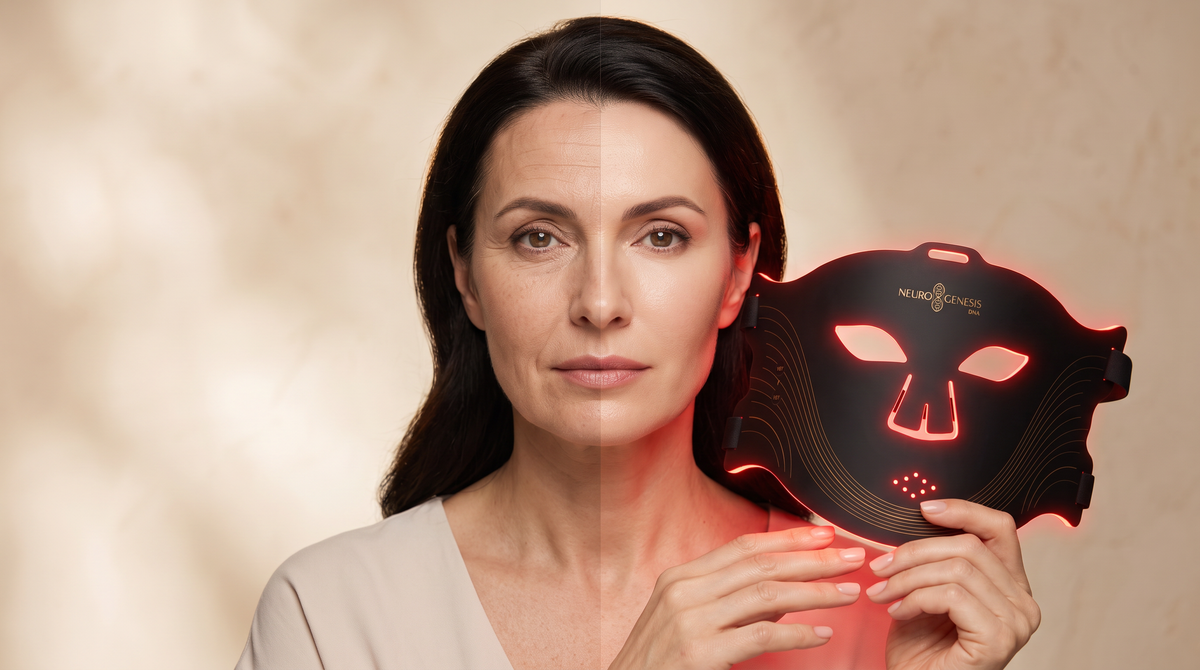
In practice, I see red light therapy as an evening ritual that tells the brain: "now we slow down". Ten minutes in which you sit, breathe and stop checking your phone already hold value for the nervous system. I have gathered the studies on the general benefits of photobiomodulation in the guide red light therapy: benefits and what the studies show.

Red light therapy device for nose and ears
660 nm red light and 810 nm near-infrared, a hands-free ritual of 10-15 minutes a day, associated with more restful sleep and a sense of calm. Limited stock.
588 RON
See the deviceHow quickly will you notice changes?
How you feel can change quickly: in the breathing study, the effects on mood appeared within the first days and grew with practice. Telomeres and telomerase, on the other hand, are biological markers that shift over weeks and months. In the studies cited above, the interventions lasted between one and three months.
What I always tell people: don't track your telomeres, track your evenings. Do you fall asleep more easily? Do you get less irritated in traffic? Do you recover faster after a difficult conversation? These are the signs that your nervous system is learning the way back to calm.
Want to understand the brain under pressure better?
On 8 November 2026 we are hosting The Future Of Mental Performance, an event about the brain, stress, focus and mental performance, with science explained in plain language and tools you can apply the very next day.

The Future Of Mental Performance, 8 November 2026
A day about the brain, stress and mental clarity, together with the NeuroGenesis DNA team.
from 180 RON
Reserve your seatFrequently asked questions
Does chronic stress really accelerate aging?
Studies show a consistent association between chronic stress and shorter telomeres, a marker of cellular aging. In a PNAS study, the women with the highest perceived stress had telomeres shorter by the equivalent of at least 10 years of aging.
What are telomeres, in short?
Telomeres are the protective caps of the chromosomes, which shorten with every cell division. Telomerase is the enzyme that can partially rebuild them. Their length is used in research as an indicator of biological age.
Can telomeres grow back?
Some studies have observed higher telomerase activity after meditation and an apparent increase in telomere length after a one-month retreat. The results are promising, but the studies are small, and exercise, sleep and stress management remain the foundation.
How do you lower cortisol naturally?
Cortisol returns more easily to a healthy rhythm through regular sleep, exercise, natural light in the morning and daily calming practices, such as slow breathing with a prolonged exhale. Consistency matters more than the length of each session.
What does breathing have to do with stress?
Slow breathing, with a longer exhale, activates the parasympathetic branch of the nervous system through the vagus nerve. A study in Cell Reports Medicine showed that just 5 minutes of breathing a day, for one month, reduced anxiety and improved wellbeing.
Start your calm ritual today
All NeuroGenesis DNA devices come with a 2-year warranty, 14-day returns and local support in Romania. Not sure where to start? Write to us on WhatsApp at 0723 299 339 and we will help you choose the right ritual for you.
See CALM OneAbout the author: Liliana Cristea
Psychologist and neuroscientist, Co-Founder and CSO of NeuroGenesis DNA. Liliana explains what happens in the brain and nervous system when we live with stress, anxiety or sleepless nights, and turns neuroscience into simple rituals that connect mind and body.
Sources
- Epel ES, Blackburn EH, Lin J et al. Accelerated telomere shortening in response to life stress. Proc Natl Acad Sci USA. 2004;101(49):17312-17315. PubMed
- Mathur MB, Epel E, Kind S et al. Perceived stress and telomere length: a systematic review, meta-analysis, and methodologic considerations for advancing the field. Brain Behav Immun. 2016. PubMed
- Tomiyama AJ, O'Donovan A, Lin J et al. Does cellular aging relate to patterns of allostasis? An examination of basal and stress reactive HPA axis activity and telomere length. Physiol Behav. 2012;106(1):40-45. PMC
- Puterman E, Lin J, Blackburn E et al. The power of exercise: buffering the effect of chronic stress on telomere length. PLoS One. 2010. PubMed
- Jacobs TL, Epel ES, Lin J et al. Intensive meditation training, immune cell telomerase activity, and psychological mediators. Psychoneuroendocrinology. 2011;36(5):664-681. PubMed
- Conklin QA, King BG, Zanesco AP et al. Insight meditation and telomere biology: the effects of intensive retreat and the moderating role of personality. Brain Behav Immun. 2018;70:233-245. Abstract
- Schneider CV, Schneider KM, Teumer A et al. Association of telomere length with risk of disease and mortality. JAMA Intern Med. 2022. PubMed
- Balban MY, Neri E, Kogon MM et al. Brief structured respiration practices enhance mood and reduce physiological arousal. Cell Rep Med. 2023;4(1). PMC
- Saltmarche AE, Naeser MA, Ho KF, Hamblin MR, Lim L. Significant improvement in cognition in mild to moderately severe dementia cases treated with transcranial plus intranasal photobiomodulation: case series report. Photomed Laser Surg. 2017;35(8):432-441. PMC
- Cassano P, Norton R, Caldieraro MA et al. Tolerability and safety of transcranial photobiomodulation for mood and anxiety disorders. Photonics. 2022;9(8):507. DOI
This information is for educational purposes and does not replace medical advice. If you have been living with intense stress, anxiety or sleep problems for a long time, talk to your doctor or a psychologist.


Leave a comment
All comments are moderated before being published.
This site is protected by hCaptcha and the hCaptcha Privacy Policy and Terms of Service apply.