
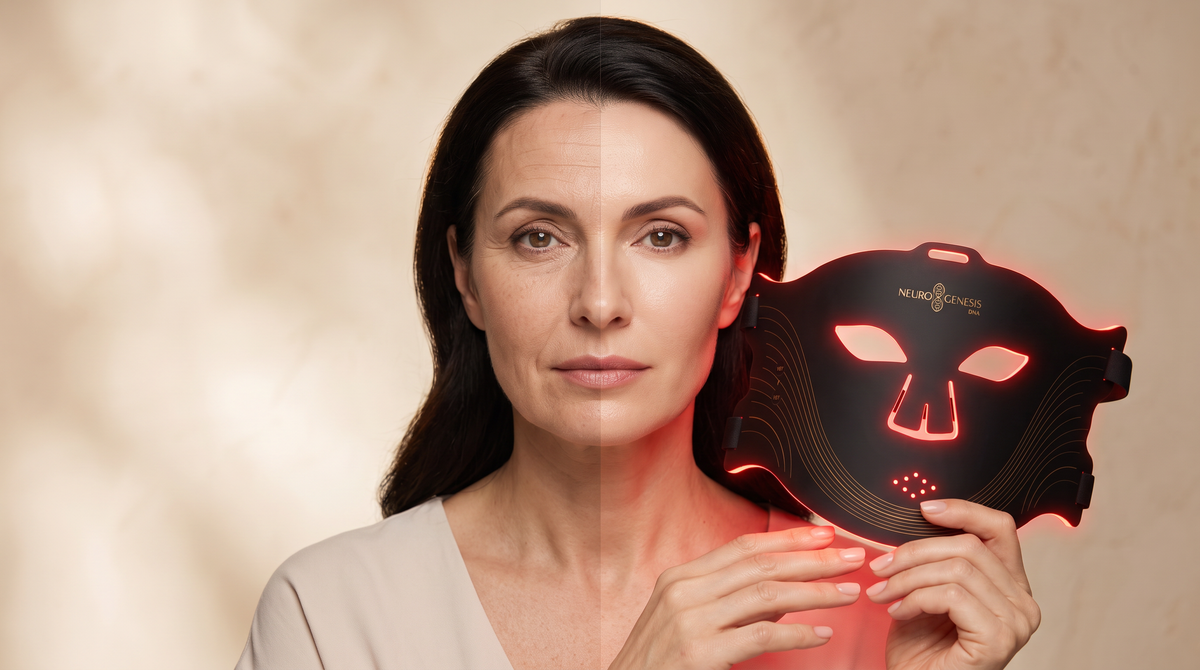
Red light therapy for wrinkles means exposing the skin to red light (630-660 nm) and near-infrared light (NIR, 810-850 nm), which stimulates fibroblasts, the cells that produce collagen and elastin. The result, confirmed by controlled studies, is firmer skin and less visible wrinkles. The most convenient option for home use is an LED mask for wrinkles, which you wear for 10-15 minutes, hands free. Below you will find what the research actually shows, how long it takes to see results and how to build a routine that truly sticks.
In short
- Red light and NIR support the energy of skin cells and help fibroblasts produce more collagen and elastin.
- In a randomized, placebo-controlled study, wrinkles were reduced by up to 36% and skin elasticity increased by up to 19%.
- A 2025 study with an LED mask used at home showed an improvement in crow's feet wrinkles in 86.2% of participants, compared with 16.7% in the placebo group.
- Results appear after 4-12 weeks of consistent use, 3-5 times a week, 10-15 minutes per session.

What is red light therapy for wrinkles and how does it work?
Red light therapy, scientifically known as photobiomodulation, uses precise wavelengths of red and near-infrared light to support the function of skin cells. It does not burn the skin, does not tan it and contains no UV rays.
The mechanism starts in the mitochondria. An enzyme found there, cytochrome c oxidase, absorbs the photons of red and NIR light, and the cell produces more ATP, meaning more energy. In the skin, the cells that benefit most are the fibroblasts, the "factories" of collagen and elastin in the dermis. With more energy available, they produce more new collagen, and over time the skin gains a denser, more elastic structure.
The two types of light work together: red light acts mainly in the superficial layers, for tone and radiance, while NIR penetrates deeper, down to the dermis, where collagen is formed. If you want the full picture of all the benefits, we wrote a separate guide on red light therapy: benefits and what the studies show.
Why do wrinkles appear and what does collagen have to do with it?
Wrinkles appear when the network of collagen and elastin in the dermis becomes thinner and disorganized. With age, fibroblasts produce less collagen, and the existing collagen breaks down faster. The sun speeds up the process: UV radiation activates the enzymes that break down collagen, a phenomenon called photoaging. We wrote in detail about protecting your skin in summer in the article sun, beach and pigmentation spots.
This is where red light therapy comes in: it does not fill wrinkles from the outside, like a filler, but helps the skin rebuild its supporting structure from within. That is why results come gradually, but they are your own skin's results.
What do the studies say about red light therapy and wrinkles?
In short: red light therapy for wrinkles has some of the most solid evidence in the whole field of photobiomodulation, with randomized, placebo-controlled studies and objective measurements, not just impressions.
Lee and colleagues (2007), in the Journal of Photochemistry and Photobiology B, divided 76 people with wrinkles into four groups: 830 nm, 633 nm, the 830/633 nm combination and placebo. After 8 sessions over 4 weeks and a 3-month follow-up, wrinkles were reduced by up to 36%, and skin elasticity increased by up to 19%. Biopsies showed a clear increase in collagen and elastin fibers and highly active fibroblasts. There were no adverse effects.
Wunsch and Matuschka (2014), in Photomedicine and Laser Surgery, followed 136 volunteers who received 30 sessions, twice a week. Compared with the control group, participants had less visible wrinkles, smoother skin and a higher collagen density, measured by ultrasound.
Mota and colleagues (2023), in Photobiomodulation, Photomedicine, and Laser Surgery, tested 660 nm red light on 137 women aged 40 to 65. After 10 sessions over 4 weeks, the volume of wrinkles around the eyes decreased by 31.6%, and participants reported a better quality of life.
Park and colleagues (2025), in Medicine, tested a home-use LED mask (630 nm and 850 nm) in a multicenter, randomized, double-blind study with 59 participants. After 12 weeks, with 9-minute sessions 5 times a week, independent evaluators saw an improvement in crow's feet wrinkles in 86.2% of users, compared with 16.7% in the placebo group. No serious adverse effects occurred.
| Study | Participants | Protocol | Main result |
|---|---|---|---|
| Lee et al., 2007 | 76 | 633 nm and/or 830 nm, twice a week, 4 weeks | Wrinkles reduced by up to 36%, elasticity +19%, more collagen on biopsy |
| Wunsch and Matuschka, 2014 | 136 | 30 sessions, twice a week | Less visible wrinkles, higher collagen density on ultrasound |
| Mota et al., 2023 | 137 women | 660 nm, 10 sessions over 4 weeks | Volume of wrinkles around the eyes reduced by 31.6% |
| Park et al., 2025 | 59 | Home LED mask, 630 nm and 850 nm, 9 minutes, 5 times a week, 12 weeks | Improvement in 86.2% of users, compared with 16.7% on placebo |
Does an LED mask for wrinkles work at home?
Yes. The 2025 study was carried out precisely on a home-use mask, and the difference from placebo was large. The secret was not extreme power, but consistency: 60 short sessions over 12 weeks.
From my experience building longevity routines, I can tell you this is the part we underestimate most often. One salon session a month cannot compete with 10-15 minutes at home, 4-5 times a week. You wear the mask while you drink your coffee, read or listen to a podcast, and the red light reaches the whole face evenly, including the forehead, the area around the eyes and the nasolabial area.

NeuroGenesis DNA Red Light Therapy Mask
336 LEDs, red light and NIR, 10-15 minute sessions for wrinkles, firmness and a brighter complexion.
888 RON
See the maskHow long until you see results?
Most people notice the first changes after 4-8 weeks, and the clearest results after about 12 weeks. In the home-use mask study, the differences from placebo became significant at 8 weeks and were maintained 4 weeks after stopping the treatment.
The order in which changes appear is usually the same: first the complexion looks more rested and brighter, then the skin becomes firmer to the touch, and wrinkles gradually soften. New collagen needs weeks to form and organize itself, which is why patience is part of the protocol.
How to use the LED mask for wrinkles: the routine that delivers results
The short answer: on clean skin, 10-15 minutes, 3-5 times a week, for at least 12 weeks. A few details make the difference:
- Clean, dry skin. Thick creams, foundation or sunscreen with mineral filters can reflect part of the red light.
- Serum after, not before. Apply your peptide, vitamin C or hyaluronic acid serum after the session, when the skin is ready to receive it.
- The same time of day. Attach the session to a habit you already have: your morning coffee or your evening routine. That way you no longer depend on motivation.
- More is not better. Photobiomodulation has an optimal dose. Stick to the recommended time instead of doubling the sessions.
- Daily sun protection. Red light therapy helps the skin produce collagen, and SPF keeps the sun from breaking it down. Together they work best.
What about the neck, décolletage and eye area?
The neck and décolletage have thinner skin than the face and are often forgotten in the skincare routine, even though they reveal the first signs of age. For them there is a dedicated mask that fits the shape and covers the area completely.

LED Beauty Mask for Neck and Décolletage
44 LEDs with red light and NIR, for wrinkles and firmness on the neck and décolletage.
525 RON
See the neck maskThe eye area is the one studied in two of the studies above, with very good results on crow's feet wrinkles. If you want targeted care here, the red light and microcurrent patches sit right on the under-eye area and the corners of the eyes.

Red Light and Microcurrent Eye Patch
Targeted care for the eye area, with red light and microcurrent, while you do the rest of your routine.
298 RON
See the Eye PatchYou can find all the devices for face, neck and eyes in the Beauty Red Light Therapy collection.
Who should not use red light therapy for wrinkles?
Red light therapy is well tolerated, and the studies above reported no serious adverse effects. Still, ask your doctor first if you are pregnant, take photosensitizing medication (for example certain antibiotics or oral retinoids), have photosensitive epilepsy, an eye condition or a suspicious skin lesion. Do not look directly into the LEDs and keep your eyes closed during the session.
Frequently asked questions
Does red light therapy really reduce wrinkles?
Yes, several controlled studies show a reduction in wrinkles after 4-12 weeks of regular use. In a randomized study with 76 participants, wrinkles were reduced by up to 36%, and biopsies showed more collagen and elastin fibers.
How long until you see results from an LED mask for wrinkles?
The first changes usually appear after 4-8 weeks of consistent use, and the clearest results after 12 weeks. The skin needs time to produce and organize new collagen.
How many times a week should I use the LED mask for wrinkles?
The studies used between 2 and 5 sessions a week. At home, 3-5 sessions of 10-15 minutes a week are a realistic rhythm that you can keep up for months.
Which is better for wrinkles: red light or near-infrared (NIR)?
Each has its own role, and together they cover more layers of the skin. Red light works in the superficial layers of the skin, while NIR penetrates deeper, towards the dermis, where the fibroblasts that produce collagen are found.
Is the LED mask for wrinkles safe?
No serious adverse effects were reported in clinical studies. Red light therapy contains no UV rays and does not tan the skin. Ask your doctor if you are pregnant, take photosensitizing medication or have an eye condition.
Start your routine for wrinkles and collagen
All NeuroGenesis DNA devices come with a 2-year warranty, 14-day returns and local support in Romania. Not sure what to choose for your skin? Write to us on WhatsApp at 0723 299 339 and we will recommend the right device in a few minutes.
See the red light maskAbout the author: Andra Manea
Co-Founder and CEO of NeuroGenesis DNA, Lifestyle Medicine and nutrition specialist. Andra builds longevity routines that combine smart nutrition, movement and wellness technologies validated by studies, with a single criterion: they have to be easy to keep up in real life.
Sources
- Lee SY et al. A prospective, randomized, placebo-controlled, double-blinded, and split-face clinical study on LED phototherapy for skin rejuvenation: clinical, profilometric, histologic, ultrastructural, and biochemical evaluations and comparison of three different treatment settings. J Photochem Photobiol B. 2007. PubMed
- Wunsch A, Matuschka K. A controlled trial to determine the efficacy of red and near-infrared light treatment in patient satisfaction, reduction of fine lines, wrinkles, skin roughness, and intradermal collagen density increase. Photomed Laser Surg. 2014. PubMed
- Mota LR et al. Photobiomodulation reduces periocular wrinkle volume by 30%: a randomized controlled trial. Photobiomodul Photomed Laser Surg. 2023. PubMed
- Park SH, Park SO, Jung JA. Clinical study to evaluate the efficacy and safety of home-used LED and IRED mask for crow's feet: a multi-center, randomized, double-blind, sham-controlled study. Medicine (Baltimore). 2025. PMC
- de Freitas LF, Hamblin MR. Proposed mechanisms of photobiomodulation or low-level light therapy. IEEE J Sel Top Quantum Electron. 2016. PubMed
This information is for educational purposes and does not replace medical advice. For skin or eye conditions, talk to your doctor before starting red light therapy.
The complete guide: Red light therapy: what it is, the studies and how to choose a device.


Leave a comment
All comments are moderated before being published.
This site is protected by hCaptcha and the hCaptcha Privacy Policy and Terms of Service apply.