
Science · Light
Red Light Therapy: how plants grow under light and what happens in your body
From photosynthesis in leaves to mitochondria producing energy — red and blue light speak the same language in two kingdoms. Here is the science of red light therapy, from NASA research to your cells.

For a living being, light means more than just seeing: it is energy and information. Plants and humans have both evolved special molecules — called chromophores — that capture certain colors and convert them into energy or biological signals. The molecule differs. The principle is identical.
And the story begins in a surprising place: in a garden grown by NASA, in space. The same research that taught plants to grow under LEDs later led to red light therapy for humans.
In short
- Plants grow under red light (~660 nm) and blue light (~450 nm) — chlorophyll absorbs them and reflects green.
- Red fuels photosynthesis and flowering; blue keeps the plant compact and controls its shape.
- NASA grew plants under LED in space — and discovered that red light heals skin. This is how red light therapy was born.
- In humans, mitochondria absorb red and infrared light through cytochrome c oxidase and produce more energy (ATP) — the principle of red light therapy.
The plant "sees" only red and blue
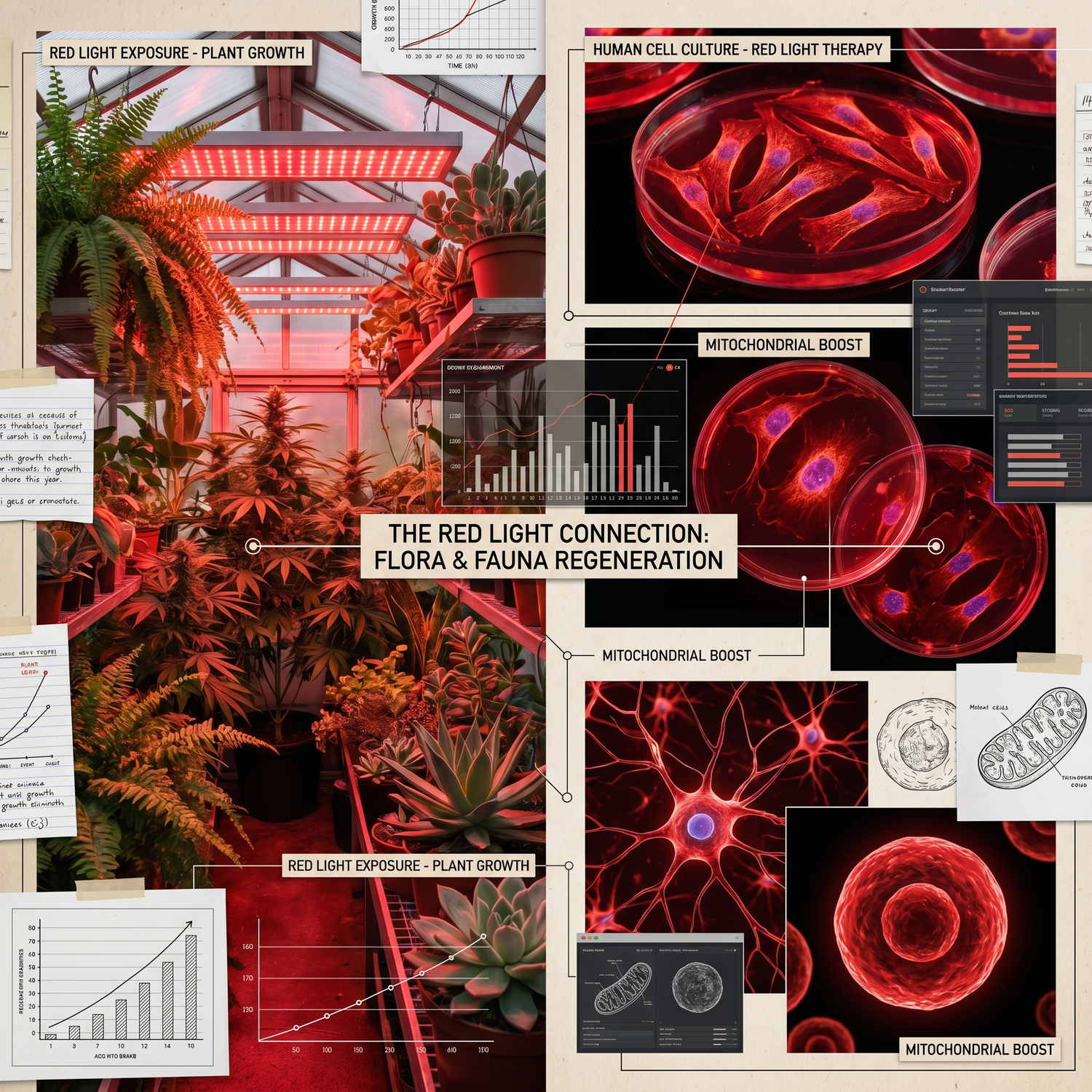
Chlorophyll most strongly absorbs red light (~660 nm) and blue light (~450 nm), but reflects green. That's why leaves are green — that color is, in fact, the light the plant rejects. Red and blue are the engine of photosynthesis and, for this reason, are the basis of LED grow lights.

Red builds. Blue disciplines.
The two colors play complementary roles in the life of the plant:
Builds
Fuels photosynthesis, increases chlorophyll content, and stimulates cell elongation and flowering, through receptors called phytochromes.
Disciplines
Keeps the plant compact and vigorous, controls stomatal opening, and guides shape, through receptors called cryptochromes.
Combined, red and blue give the characteristic light of horticultural LED systems — the spectrum that plants use most efficiently.

Chlorophyll for the plant, cytochrome for man — the same grammar of light, in two kingdoms.
NASA grew plants in space — and discovered something else
To feed astronauts on long missions, NASA pioneered growing plants under red and blue LEDs. Radishes grown this way developed more chlorophyll, more antioxidants, and more stored energy.
But the real surprise came from elsewhere: researchers observed that wounds on their own skin healed faster under the same red LEDs. That was the moment when light for plants became light for people — and red light therapy was born.
Good to know
The scale differs enormously, but the principle does not: the plant converts approximately 0.5–1.5% of the received light into energy, humans much less — around 0.2%. In both cases, a receptor molecule captures a certain color of light and converts it into energy for the cell.
Your body has its own light pigment
Just as the plant has chlorophyll, the body has cytochrome c oxidase — an enzyme in the mitochondria that functions as a light receptor. It absorbs red light (600–750 nm) and near-infrared light (750–1100 nm), precisely the wavelengths in the "optical window" that penetrate deepest into the tissue.

Mitochondria feed on light
When cytochrome c oxidase absorbs these photons, the electron transport chain accelerates: the mitochondria produce more ATP — the energy currency of the cell — modulate reactive oxygen species, and release nitric oxide, which relaxes blood vessels.
Basically, it's a gentle form of "cellular photosynthesis." This is also the principle behind red light therapy — the red light therapy used on the skin to support cellular energy, soothing, and recovery.
And blue? In humans, it speaks to the clock
Blue light has another role in humans: through special cells in the retina, it regulates the circadian rhythm — the internal clock that controls sleep. In addition, it has an antibacterial effect, used against acne.
Precisely why context matters: the same blue light that keeps your mind awake during the day can disrupt your sleep at night, and in excess can stress the skin. In photobiology, wavelength and dose are everything.
Bring the science of red light therapy home
The NeuroGenesis DNA brand brings the same red light and near infrared therapy initially studied by NASA — in devices designed for your skin.
Discover products with red light and near infrared therapy

Leave a comment
All comments are moderated before being published.
This site is protected by hCaptcha and the hCaptcha Privacy Policy and Terms of Service apply.