
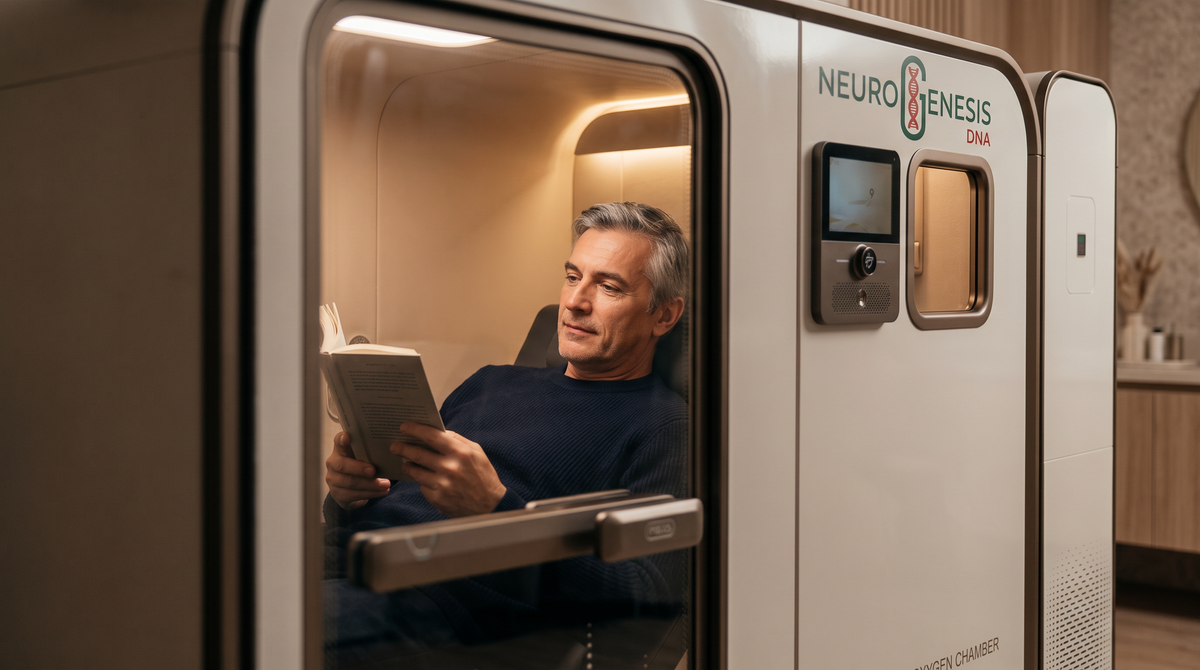
Hyperbaric oxygen therapy (HBOT) supports the brain by increasing the oxygen dissolved in the blood and cerebral blood flow: in a randomised study published in Aging (Hadanny and colleagues, 2020), 60 sessions at 2.0 ATA improved attention and information processing speed in healthy older adults, with effect sizes of 0.745 and 0.788. For people living with brain fog, a second randomised, double-blind study showed improvements in cognition, energy and sleep. At NeuroGenesis DNA we work with hyperbaric chambers for clinics and for home use, and below I explain, as a psychologist and neuroscience researcher, what happens in the brain during these sessions, what the studies show and where they stop.
In short
- The brain weighs about 2% of body weight, yet it uses roughly one fifth of the oxygen. It is the organ that feels a lack of energy first, and brain fog is often the sign of a metabolically tired brain.
- Memory and attention: in 63 healthy adults aged 64 and over, 60 sessions of hyperbaric oxygen therapy at 2.0 ATA, 90 minutes each, improved global cognition, attention and processing speed and increased blood flow in the frontal areas of the brain (Hadanny, 2020).
- Brain fog: in 73 people with persistent symptoms after COVID-19, 40 sessions improved cognition, attention, executive functions, energy and sleep compared with placebo (Zilberman-Itskovich, 2022). More than a year after the last session, many of the benefits were maintained (Hadanny, 2024).
- Oxygen is the fuel of the neurons' mitochondria, the same ones that red light therapy supports, as we explain in the complete guide to red light therapy. The protocols in the studies are carried out under medical supervision, and different pressures have different effects.

What does hyperbaric oxygen therapy do in the brain?
The direct answer: under pressure, oxygen dissolves directly into the plasma and reaches the fine capillaries of the brain more easily, and repeated sessions set repair processes in motion, from new blood vessels to new mitochondria.
When you breathe ordinary air, haemoglobin is already almost full, so more oxygen at normal pressure changes little. In a hyperbaric chamber, the pressure opens a second transport route, the plasma, which also reaches the places where red blood cells struggle to pass. I explained the physics of this process in the article Hyperbaric oxygen: what it is and how oxygen reaches every cell.
For the brain, this matters enormously. Neurons cannot build large energy reserves and live on the oxygen the blood brings them moment by moment. When circulation in an area drops, with age, after an illness or after months of stress and too little sleep, the neurons enter a kind of "economy mode": they work, but more slowly and with more effort. Many people describe exactly this as brain fog.
What is brain fog and why does it appear?
Brain fog is a description, not a diagnosis: slowed thoughts, difficulty concentrating, words that do not come on time, the feeling of reading the same sentence three times. In my practice I hear it described almost identically by very different people.
Research links it to several overlapping mechanisms: reduced cerebral blood flow in certain areas, low-grade inflammation in the brain, mitochondria that produce less energy, fragmented sleep and chronic stress, which keeps the nervous system on alert. I wrote about the way stress leaves its mark right down at the level of the cells in the article on chronic stress and telomeres.
The encouraging part is that many of these mechanisms are reversible, because the brain remains plastic throughout life.
What do the studies say about hyperbaric oxygen therapy and memory?
The direct answer: in older adults without neurological disease, hyperbaric oxygen therapy improved global cognitive function, and the effect went hand in hand with better cerebral blood flow. The most cited study comes from the Sagol Center for Hyperbaric Medicine in Israel.
Hadanny and colleagues, 2020 (Aging). 63 healthy adults aged 64 and over, with an average age of almost 70, were randomly divided into two groups. The HBOT group received 60 sessions over 3 months, 5 per week, at 2.0 ATA, with 90 minutes of 100% oxygen through a mask and 5-minute air breaks every 20 minutes. Compared with the control group, global cognition improved significantly. The biggest gains appeared in attention (effect size 0.745) and in information processing speed (0.788), and executive functions improved too. Perfusion MRI showed increased blood flow in several areas of the frontal and parietal cortex, regions involved in attention, planning and working memory.
Shapira and colleagues, 2021 (Aging). The Tel Aviv team observed, in older adults with significant memory loss, increased cerebral blood flow and better cognitive performance after hyperbaric oxygen therapy. These are preliminary data, from small groups, and I read them as a research direction, not as a promise.
As a psychologist, I pay particular attention to attention itself: you cannot remember what you did not process well in the first place. This is why clearer attention often feels like "better memory".
Can hyperbaric oxygen therapy reduce brain fog?
Yes, at least in one well-studied group: people with cognitive symptoms that remain after COVID-19, where brain fog is one of the most frequent complaints.
Zilberman-Itskovich and colleagues, 2022 (Scientific Reports). 73 adults with symptoms lasting at least 3 months received either hyperbaric oxygen therapy or a placebo (sham) session, without knowing which group they were in. The protocol: 40 sessions, 5 per week, at 2.0 ATA, 90 minutes of 100% oxygen each. Compared with placebo, the HBOT group had significant improvements in global cognition, attention and executive functions, plus more energy, better sleep and fewer psychological symptoms.
Imaging linked the improvements to better perfusion in the insula and in areas of the frontal lobe, regions that connect cognition with emotion. The authors speak openly about neuroplasticity.
Hadanny and colleagues, 2024 (Scientific Reports). The same team re-evaluated 31 of the treated patients, on average 486 days after the last session. Quality of life, sleep, neuropsychiatric symptoms and pain remained improved, at levels close to those measured immediately after treatment. For me, this is the most important signal.
| Study | Who took part | Protocol | What improved |
|---|---|---|---|
| Hadanny 2020, Aging | 63 healthy older adults, 64+ years | 60 sessions, 2.0 ATA, 90 minutes, 3 months | Global cognition, attention, processing speed, executive functions, cerebral blood flow |
| Zilberman-Itskovich 2022, Scientific Reports | 73 adults with post-COVID symptoms | 40 sessions, 2.0 ATA, 90 minutes, compared with placebo | Cognition, attention, executive functions, energy, sleep, psychological symptoms, pain |
| Hadanny 2024, Scientific Reports | 31 of the patients above | Re-evaluation after more than a year | The benefits for sleep, quality of life, psychological symptoms and pain were maintained |
All the studies above used clinical protocols, at 2.0 ATA, under medical supervision. The results cannot be automatically transferred to other pressures or other protocols.
Why would oxygen help neuroplasticity?
The explanation proposed by the researchers at the Sagol Center is called the hyperoxic-hypoxic paradox: the brain reacts both to the level of oxygen and to its variations.
In the review published in Biomolecules in 2020, Hadanny and Efrati describe how alternating between high oxygen and air breaks activates the HIF-1 factor, which switches on the genes for new blood vessels, and the formation of new mitochondria. The brain learns from contrast and repetition, just as it does with a new habit. This is why the studies use 40 to 60 sessions, not a single one.

NeuroGenesis DNA hyperbaric chambers
15 models, between 1.5 and 2.0 ATA, for clinics, spas, hotels and home use. Delivery, installation and training included.
Personalised offer within 24 hours
Request an offerWhat pressure and how many sessions do the studies use for the brain?
The studies with cognitive results used 2.0 ATA, 90-minute sessions with 100% oxygen and air breaks, 5 times a week, for 2 to 3 months. It is a medical protocol, set and monitored by a doctor.
Pressure makes the difference. At 2.0 ATA, far more oxygen dissolves into the plasma than at 1.3 ATA, and the Undersea and Hyperbaric Medical Society considers that exposures below 1.5 ATA do not yet have evidence for the recognised medical indications. Different pressures have different effects and indications, so we cannot assume that a relaxation session at 1.3 ATA brings the same results as the protocols in the studies.
The models we work with at NeuroGenesis DNA operate between 1.5 and 2.0 ATA, so a clinic or a longevity centre can work at the pressures used in research, with a doctor who sets the protocol.
How does oxygen complement red light therapy for the brain?
Oxygen and red light therapy work in the same place: the neuron's mitochondria. Oxygen is the fuel, while red light and near-infrared light (NIR) are absorbed by cytochrome c oxidase, the enzyme that uses that very oxygen to produce energy (ATP).
Michael Hamblin describes in his 2016 review how red light therapy applied to the head supports the neurons' energy, cerebral blood flow and an anti-inflammatory response, which are exactly the mechanisms involved in brain fog.
The practical difference: a course of hyperbaric oxygen therapy is done in a clinic or at home, following a protocol, while red light therapy for the brain can become a daily 10 to 15 minute ritual. One of the shortest routes to the brain is the nose, where the bone is much thinner than at the forehead. I explained this route in detail in the article Red light for the brain: intranasal photobiomodulation, anxiety and sleep.

Red Light Therapy Device for the Nose and Ears
660 nm red light and 810 nm infrared light, with probes for the nose and for the ears. A hands-free ritual of 10 to 15 minutes a day, which brings red light closer to the brain.
588 RON · limited stock
See the deviceWhat can you do from today for a clearer mind?
Oxygen and red light work best on prepared ground. Here is what I recommend to the people who come to me with brain fog, before any device:
- Deep sleep. At night, the glymphatic system "washes" the brain of metabolic waste. Without deep sleep, morning fog is almost inevitable. I wrote about this in the article on deep sleep and the glymphatic system.
- Daily movement. Aerobic effort increases cerebral blood flow and the growth factors of neurons.
- Real breaks from stress. A few minutes of slow breathing, with a longer exhale, take the nervous system out of alert mode. The CALM One pendant (150 RON) helps you slow down your exhale without counting.
Is hyperbaric oxygen therapy safe for the brain?
Yes, serious adverse effects are rare when the sessions are done correctly, with a medical assessment beforehand and trained staff. The most frequent discomfort is pressure in the ears, as on a plane.
Medical hyperbaric oxygen therapy is carried out under medical supervision. People with lung or ear conditions, with epilepsy or on complex treatments need their doctor's approval, and brain fog that appears suddenly calls for a consultation first. Hyperbaric oxygen therapy can be part of a longevity routine, but it does not replace diagnosis and treatment.
Frequently asked questions
What effect does hyperbaric oxygen therapy have on the brain?
Hyperbaric oxygen therapy increases the amount of oxygen dissolved in the plasma and, after repeated sessions, is associated with better cerebral blood flow. In a randomised study published in Aging in 2020, 60 sessions at 2.0 ATA improved global cognition, attention and processing speed in healthy older adults.
Does hyperbaric oxygen therapy help memory?
The studies show promising results. In healthy older adults, the biggest improvements appeared in attention and processing speed, two functions that everyday memory depends on. In older adults with memory loss, preliminary data show better cerebral blood flow and better cognitive performance.
Can hyperbaric oxygen therapy reduce brain fog?
In people with persistent cognitive symptoms after COVID-19, a randomised, double-blind study with 73 participants showed that 40 sessions at 2.0 ATA improved cognition, attention, executive functions, energy and sleep compared with placebo. Many of the benefits were maintained more than a year after treatment.
How many hyperbaric oxygen therapy sessions are needed for the brain?
The studies with cognitive results used between 40 and 60 sessions, 5 times a week, 90 minutes each at 2.0 ATA, with air breaks. The protocol is set by a doctor, depending on the goal and on the state of health.
Is 1.3 ATA as effective as 2.0 ATA for the brain?
We cannot assume that. At 2.0 ATA, far more oxygen dissolves into the plasma than at 1.3 ATA, and the cognition studies cited here used 2.0 ATA. The Undersea and Hyperbaric Medical Society considers that exposures below 1.5 ATA do not yet have evidence for medical indications. Different pressures have different effects and indications.
Do you want a hyperbaric chamber for your clinic or for your home?
We have 15 models, between 1.5 and 2.0 ATA, for clinics, spas, hotels and home use. Delivery, installation and training are included, and you receive your personalised offer within 24 hours. Any questions? Write to us on WhatsApp at 0723 299 339.
Request an offerNeuroGenesis DNA red light therapy devices come with a 2-year warranty and 14-day returns.
About the author: Liliana Cristea
Psychologist and neuroscience researcher, Co-Founder and CSO of NeuroGenesis DNA. Liliana studies the connection between the brain, emotions and the body and explains in plain language what happens in the nervous system under stress, in mental fatigue and in sleep, so that everyone can build routines that truly help them.
Read also
- The complete guide to red light therapy
- Hyperbaric oxygen: what it is and how oxygen reaches every cell
- Red light for the brain: intranasal photobiomodulation, anxiety and sleep
Sources
- Hadanny A, Efrati S et al. Cognitive enhancement of healthy older adults using hyperbaric oxygen: a randomized controlled trial. Aging (Albany NY). 2020;12(13):13740-13761. Aging
- Zilberman-Itskovich S, Catalogna M, Sasson E et al. Hyperbaric oxygen therapy improves neurocognitive functions and symptoms of post-COVID condition: randomized controlled trial. Sci Rep. 2022;12. doi:10.1038/s41598-022-15565-0. Scientific Reports
- Hadanny A, Zilberman-Itskovich S, Catalogna M et al. Long term outcomes of hyperbaric oxygen therapy in post covid condition: longitudinal follow-up of a randomized controlled trial. Sci Rep. 2024;14:3604. Scientific Reports
- Shapira R, Gdalyahu A, Gottfried I et al. Hyperbaric oxygen therapy alleviates vascular dysfunction and amyloid burden in an Alzheimer's disease mouse model and in elderly patients. Aging (Albany NY). 2021;13(17):20935-20961. Aging
- Hadanny A, Efrati S. The Hyperoxic-Hypoxic Paradox. Biomolecules. 2020;10(6):958. Biomolecules
- Undersea and Hyperbaric Medical Society. Indications for Hyperbaric Oxygen Therapy. UHMS
- Hamblin MR. Shining light on the head: Photobiomodulation for brain disorders. BBA Clin. 2016;6:113-124. PubMed
This information is for educational purposes and does not replace medical advice. Medical hyperbaric oxygen therapy is carried out under medical supervision, and the pressure, duration and number of sessions are set by a doctor. Wellness hyperbaric chambers and red light therapy devices are not intended to diagnose or treat diseases.


Leave a comment
All comments are moderated before being published.
This site is protected by hCaptcha and the hCaptcha Privacy Policy and Terms of Service apply.